


Types of AI: A Complete Guide to Artificial Intelligence
You interact with artificial intelligence every day, even when you do not realize it. When your email filters out unwanted messages, your navigation app reroutes you around sudden highway traffic, or your streaming service suggests a song you end up playing on repeat, software is making calculated predictions on your behalf.
Yet, conversations around artificial intelligence often feel confusing. News headlines mix science fiction scenarios with everyday business tools, leaving founders, professionals, and curious readers wondering what the technology actually does right now.
To make sense of the field, engineers and researchers group artificial intelligence into specific categories. Understanding the types of artificial intelligence gives you a clear mental model. It helps you separate current practical tools from long-term research theories, and it equips you to choose the right software for your personal workflow or business operations.
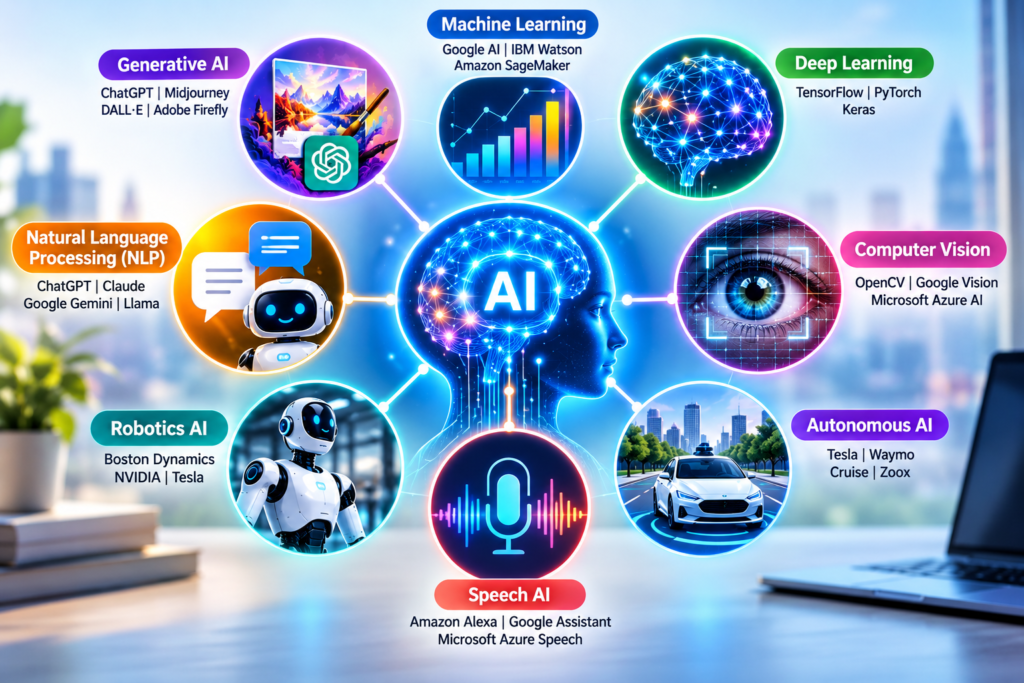
What Are the Primary Types of Artificial Intelligence
When experts categorize artificial intelligence, they usually look through two distinct lenses. The first lens evaluates capability, measuring what the system can achieve compared to human intelligence. The second lens evaluates functionality, examining the underlying architecture and how the machine processes information.
Both classification methods are useful because they answer two different questions: what can the system do, and how does its mind work?
Capability-Based Classification
Capability describes the scope of problems an algorithm can handle. Under this framework, systems fall into three progressive tiers:
- Artificial Narrow Intelligence (ANI)
- Artificial General Intelligence (AGI)
- Artificial Superintelligence (ASI)
Every single AI application running on a server, computer, or phone today belongs strictly to the first category. The second and third tiers remain theoretical concepts and long-term research ambitions.
Functionality-Based Classification
Functionality describes the technical mechanism behind how software stores memory, assesses incoming signals, and reacts to its environment. Computer scientist Ameet Joshi and other foundational theorists established four distinct stages of functionality:
- Reactive Machines
- Limited Memory
- Theory of Mind
- Self-Aware AI
Just like the capability model, only the first two functional stages exist in working code today. The remaining two stages involve cognitive awareness and emotional comprehension that modern computing cannot yet replicate.
Understanding AI by Capability: Narrow, General, and Super AI
To understand where current software stops and theoretical speculation begins, you need to look closer at the three tiers of capability.
Artificial Narrow Intelligence in Daily Operations
Artificial Narrow Intelligence, often called Weak AI, is software engineered and trained to execute a single task or a closely related group of tasks with exceptional proficiency.
The word narrow does not mean the software is basic or weak in power. It simply means the software lacks flexibility. A chess engine can evaluate millions of potential moves per second and defeat any human grandmaster on Earth, but that same program cannot book a doctor appointment, write a recipe, or detect credit card fraud. Its mathematical architecture is dedicated entirely to chess board calculations.
Today, narrow AI runs the global digital economy. Stanford University’s Artificial Intelligence Index consistently tracks how rapidly narrow models have matched or exceeded human benchmarks in specific domains, including image classification, reading comprehension tests, and basic code writing.
When you use language models to draft letters, voice recognition engines to transcribe audio, or optical systems in warehouse robotics, you are utilizing narrow AI. The software processes massive amounts of input data, maps patterns, and produces outputs based on probabilistic math. It does not think, feel, or reflect on its output.
The Frontier of General and Super AI
Artificial General Intelligence, frequently referred to as Strong AI, represents a theoretical system that possesses cognitive competence across the full spectrum of human intellectual tasks.
If an AGI system existed, it would learn unfamiliar subjects without requiring specialized retraining datasets. It could transfer lessons learned from acoustic music theory over to financial market modeling, reason through novel ethical dilemmas, understand abstract metaphors, and adapt to unpredictable physical environments just like a human worker.
Researchers hold widely differing views on when or if computer science will achieve genuine general intelligence. Some computer scientists point toward modern foundation models as early hints of general capability, while others argue that statistical pattern matching cannot produce genuine comprehension, commonsense reasoning, or contextual judgment.
Artificial Superintelligence represents a hypothetical stage beyond general intelligence. Theorized by philosophers like Nick Bostrom, superintelligence describes an entity with intellectual capability that significantly surpasses the collective mental performance of all human minds combined across scientific creativity, strategic reasoning, and general wisdom. Because an ASI system does not exist, it remains an area of philosophical inquiry and safety governance rather than practical engineering.
Understanding AI by Functionality: From Reactive Machines to Self-Aware Systems
Viewing artificial intelligence through its internal functional mechanism helps clarify how algorithms process incoming data and whether they can retain past context.
Reactive and Limited Memory Systems
The first functional stage consists of reactive machines. These systems live purely in the present moment. They do not store memories, track past experiences, or use historical records to inform future choices. When presented with a specific input, a reactive system follows fixed mathematical calculations to produce an output.
IBM’s Deep Blue, the computer that famously defeated world chess champion Garry Kasparov in 1997, is the classic example of a reactive machine. Deep Blue evaluated the current pieces on the board and projected the most favorable moves according to programmed game theory. It possessed no memory of prior games, no record of its opponent’s habits outside the board, and no capacity to learn from mistakes made ten minutes earlier. Modern spam filters that check email text against fixed keyword rules operate under similar reactive principles.
Limited memory systems represent the next evolutionary stage, and they power almost all modern artificial intelligence breakthroughs. Unlike reactive systems, limited memory programs can observe dynamic external data points, store those observations temporarily or persistently, and update internal weights based on that accumulated experience.
Autonomous vehicles rely heavily on limited memory architecture. When a self-driving car navigates an intersection, it monitors surrounding vehicles, pedestrians crossing the road, road markings, and current speed. It tracks how nearby objects have moved over the last several seconds to predict where they will be three seconds from now.
Generative models and predictive recommendation engines also belong to the limited memory class. They are trained on vast historical corpora of text, code, or visual media, retaining those learned parameters to generate responses or suggest actions when prompted.
Theory of Mind and Conscious Machines
The final two functional categories remain strictly theoretical at this point in computer science history.
Theory of mind is a concept borrowed directly from psychology. In humans, it refers to the understanding that other people have their own private thoughts, emotions, beliefs, motives, and mental states that influence their actions.
An artificial intelligence system equipped with a true theory of mind would not merely detect sentiment through keywords in customer service tickets. Instead, it would understand that an upset customer has personal expectations, unstated frustrations, and cultural background factors shaping their reaction. It would adjust its communication style by recognizing the internal mental state of the person talking to it. Current voice assistants and conversational chatbots can mimic empathetic phrasing, but they do not possess an underlying model of the human speaker’s inner world.
Self-aware AI is the ultimate theoretical stage. A self-aware machine would have an internal sense of identity, conscious experience, and direct awareness of its own existence, strengths, and limits. It would understand its feelings, recognize its condition within an environment, and hold intrinsic motivations beyond direct human programming. No contemporary system displays self-awareness, and developing conscious software remains far beyond existing technological horizons.
Real-World Applications and Popular Tools Across Different Types of AI Technology
To see how these concepts translate into real-world software, take a look at the tools that power contemporary workplaces. Organizations across industries deploy specialized models to handle repetitive administrative tasks, analyze complicated market trends, and draft communications.
Here is an overview of how theoretical classifications align with actual software categories and daily use cases.
| Capability Tier | Functional Type | Common Software Category | Leading Examples | Practical Business Use Case |
| Narrow AI | Reactive | Game Engines and Rule Filters | Deep Blue, Stockfish, Basic Spam Filters | Automated rule validation, structured sorting, static fraud checks |
| Narrow AI | Limited Memory | Large Language Models | ChatGPT, Claude, Gemini | Drafting correspondence, summarizing reports, code generation |
| Narrow AI | Limited Memory | Computer Vision Platforms | YOLO, Google Lens, AWS Rekognition | Quality assurance on assembly lines, automated document scanning |
| Narrow AI | Limited Memory | Predictive Analytics Software | Salesforce Einstein, DataRobot | Forecasting quarterly sales, inventory planning, churn reduction |
| Narrow AI | Limited Memory | Autonomous Navigation Engines | Tesla Full Self-Driving, Waymo Driver | Route optimization, delivery logistics, warehouse freight transport |
| General AI | Theory of Mind (Theoretical) | Adaptive Autonomous Agents | Not currently developed | Cross-domain problem solving, autonomous corporate management |
| Super AI | Self-Aware (Theoretical) | Post-Human Intelligence | Not currently developed | Global systemic modeling, multi-century scientific discovery |
Every day, workers use these practical narrow tools to save time and reduce manual data entry. According to recent McKinsey surveys on global business trends, more than two thirds of enterprise organizations report using machine learning tools in at least one operational function, most notably marketing, product development, and customer service.
How Small Businesses and Professionals Can Choose the Right AI
Adopting artificial intelligence does not require a deep degree in mathematics or millions of dollars in infrastructure investment. Because almost all modern solutions are narrow applications delivered through standard software subscriptions, you can pick specific tools that directly resolve operational bottlenecks.
Audit Repetitive Daily Workflows
Begin by identifying where you or your team spend time on repetitive, rules-based tasks. Are you spending three hours every Monday morning sorting customer receipts, writing formulaic email confirmations, or typing transcription notes from client meetings?
These structured, data-heavy tasks are ideal for narrow AI applications.
For transcription and meeting synthesis, platforms like Otter.ai or Fireflies run narrow audio-processing models that transcribe spoken sentences and extract action items.
For written communication and research summaries, general text models help draft outlines and polish customer-facing language, freeing your schedule for high-priority strategic decisions.
Prioritize Data Security and Accuracy
Before you feed internal company information or proprietary customer data into third-party AI software, review the vendor data privacy terms.
Many free consumer tools use uploaded inputs to train future iterations of their models. If you handle confidential client records, financial statements, or medical files, you need commercial agreements that guarantee data privacy, encryption, and zero training retention.
Keep in mind that machine learning models generate responses based on pattern likelihoods, which means they can produce factual errors with confident phrasing. Establish human-in-the-loop workflows where team members review important figures, legal text, and strategic deliverables before anything gets sent to external partners.
Start with Small Pilot Projects
Avoid trying to rebuild your entire business model around artificial intelligence overnight. Pick one isolated problem with measurable outcomes.
For example, a small local retail store might implement an AI-driven inventory forecasting plugin for their e-commerce website to cut overstock expenses. A marketing consultancy might adopt image generation and editing tools to draft client mood boards faster.
Monitor the pilot project for ninety days. Measure the time saved, calculation errors eliminated, or revenue gained. Once you demonstrate a tangible return on investment from one narrow tool, expand your toolkit into adjacent operational areas.
Frequently Asked Questions About Types of Artificial Intelligence
What is the most common type of artificial intelligence used today?
Artificial Narrow Intelligence (ANI) with a limited memory architecture is the most widespread form of AI in existence. Every commercial platform available today, from smart home voice assistants and digital translation engines to corporate predictive analytics tools, belongs to this category.
Is generative AI considered artificial general intelligence?
No. Generative AI tools like text generators and image creators are sophisticated examples of narrow AI. While they produce creative, fluent outputs across numerous subjects, they rely on statistical patterns learned during training. They do not possess independent understanding, generalized reasoning, or consciousness.
What is the primary difference between reactive machines and limited memory AI?
Reactive machines cannot store past information or recall prior events to guide new actions. They only analyze the specific data presented to them in the immediate moment. Limited memory systems can record past observations, recognize evolving trends, and adjust their future predictions based on that accumulated data.
Will artificial general intelligence replace human workers completely?
General AI remains theoretical, and experts disagree sharply on when or if it will ever be built. Modern narrow AI tools are designed to automate specialized tasks rather than replace human workers wholesale. Professionals who learn to use these tools effectively generally find that automation removes administrative chores, allowing them to focus more attention on creative problem solving, client relationships, and high-level strategy.
Disclaimer
The information provided in this article is for general informational and educational purposes only.
Artificial intelligence technology, vendor features, pricing, and system capabilities evolve rapidly. While every effort is made to ensure the accuracy and timeliness of the content at the time of publication, information may change over time.
Mention of specific software platforms, tools, or brand names does not constitute an endorsement, official partnership, or commercial recommendation. All trademarks, service marks, and company names referenced belong to their respective owners and are used strictly for identification purposes.
Nothing in this guide should be construed as legal, technical, financial, or data privacy advice. Before integrating third-party artificial intelligence software or uploading sensitive company data into external platforms, always review the vendor’s terms of service, security documentation, and privacy agreements to ensure compliance with relevant regulations.