


Trending Gadgets in USA: What Beginners Should Know in 2026
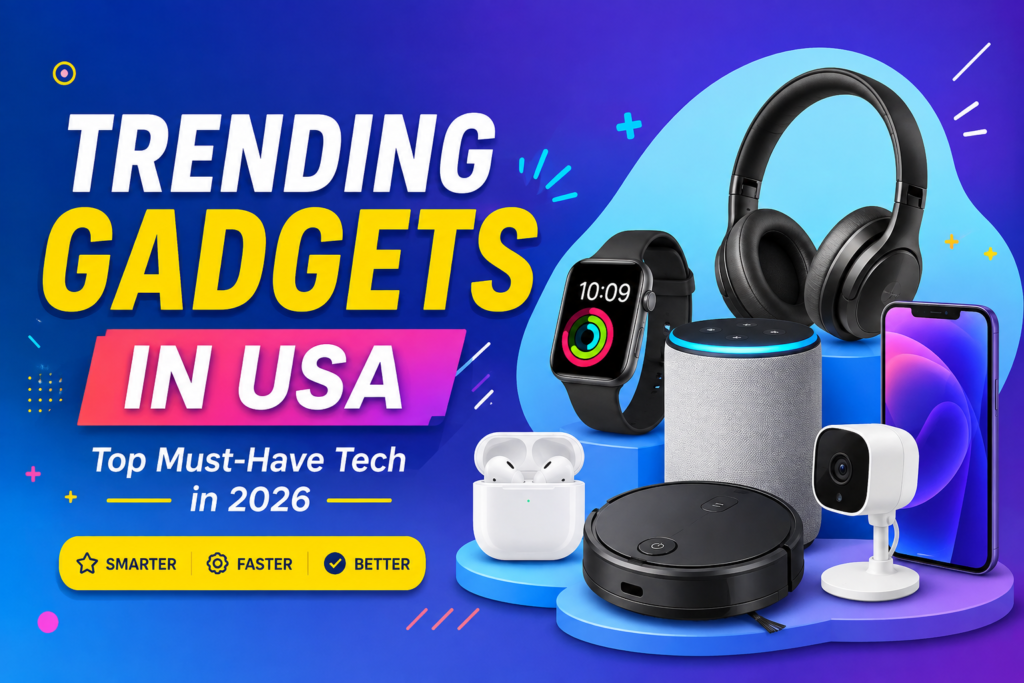
Technology is changing quickly, but not every new gadget deserves a place on your shopping list. The trending gadgets in USA in 2026 are increasingly focused on practical artificial intelligence, connected homes, wearable technology, health tracking, automation and entertainment.
For beginners, the biggest challenge is separating genuinely useful technology from products that are simply receiving attention online.
The good news is that today’s gadgets are becoming easier to use. Many devices can connect to smartphones, respond to voice commands, automate routine tasks and use AI to provide personalized features.
The U.S. consumer technology market remains enormous. The Consumer Technology Association projected U.S. consumer technology industry revenue of approximately $565 billion in 2026, representing 3.7% year-over-year growth.
So, which gadgets and categories are worth watching?
1. AI-Powered Gadgets
Artificial intelligence is one of the biggest forces shaping consumer technology in 2026.
Instead of existing only inside software, AI is increasingly built directly into everyday devices. Smartphones, computers, headphones, cameras, wearables and home products can now use AI for tasks such as summarization, translation, image processing, voice assistance and automation.
CES 2026 coverage also highlighted a new generation of AI wearables designed to act as personal assistants or “second brains,” including smart rings and small wearable devices capable of recording, organizing and summarizing information.
For beginners, the important question isn’t simply “Does it have AI?”
Ask:
- What does the AI actually do?
- Does it save time?
- Does it work without a subscription?
- What personal data does it collect?
2. Smartwatches and Health Wearables
Smartwatches remain one of the most practical categories of trending gadgets.
They can provide notifications, fitness tracking, navigation, workout information and other health-related measurements.
Pew Research Center reported in June 2026 that 37% of U.S. adults say they own a smartwatch such as an Apple Watch or Google Pixel Watch.
The category is also becoming more sophisticated. Newer watches are adding AI-powered coaching, improved GPS, sleep insights and additional health-monitoring capabilities.
However, beginners should remember that wearable health measurements are not automatically medical diagnoses. Look at the device’s supported features and regulatory status before treating any health metric as clinically meaningful.
3. Smart Glasses
Smart glasses are another category gaining attention in the United States.
Modern smart glasses increasingly combine cameras, microphones, speakers and AI assistants without requiring users to constantly look at a phone.
Potential uses include:
- Hands-free voice assistance
- Photography and video
- Navigation
- Translation
- Music and calls
- AI-powered information
The smart-glasses category is attracting attention because manufacturers are trying to make wearable computing more natural and less intrusive. TechInsights identifies smart glasses as a particularly important growth area within wearables in its 2026 consumer-electronics outlook.
Privacy should be a major consideration, especially for glasses containing cameras.
4. Smart Home Gadgets
Smart home technology continues to move from novelty toward everyday convenience.
Popular categories include smart speakers, video doorbells, robot vacuums, smart thermostats, cameras, smart locks and connected lighting.
Pew’s 2026 survey found that 35% of U.S. adults have an AI-enabled smart speaker, while 18% reported having an AI-enabled smart doorbell. Robot vacuums and smart thermostats were each reported by about one in ten adults as AI-enabled devices.
Another important development is Matter, a smart-home interoperability standard designed to make compatible devices work more easily across ecosystems. TechInsights expects Matter adoption to continue developing during 2026.
For beginners, compatibility should come before flashy features. Check whether a gadget works with the smart-home platform you already use.
5. AI and Robotic Cleaning Gadgets
Robot vacuums are becoming smarter, with manufacturers focusing on improved navigation, object recognition, automated cleaning and increasingly sophisticated home mapping.
CES 2026 coverage featured advanced robot vacuums, robotic lawn equipment and other automation products, showing how robotics is expanding beyond simple floor cleaning.
For a beginner, an expensive robot is not automatically better.
Consider:
- Floor type
- Home size
- Obstacle detection
- Battery life
- Replacement parts
- App quality
- Maintenance requirements
A simpler robot that performs reliably may provide more value than a feature-heavy model.
6. Wireless Audio and Smart Earbuds
Wireless earbuds continue to be among the easiest gadgets for beginners to adopt.
The latest models increasingly combine active noise cancellation, better microphones, spatial audio, voice assistants and AI-powered features.
They are useful for commuting, travel, remote work, exercise and entertainment.
When comparing earbuds, prioritize comfort, battery life and microphone quality rather than focusing only on the number of advertised features.
7. AI PCs and Smarter Personal Computing
AI is also changing laptops and personal computers.
Modern AI-focused computers increasingly include dedicated processing hardware designed to handle certain AI workloads locally. This can improve performance for supported applications and potentially reduce dependence on cloud processing for some tasks.
However, beginners should avoid buying an “AI PC” simply because the label sounds futuristic.
Check whether the software you actually use benefits from the hardware before paying a premium.
8. How to Choose a Trending Gadget Without Wasting Money
Popularity should never be the only buying criterion.
Before purchasing a trending gadget, ask five questions:
Does it solve a real problem?
A gadget should make something easier, faster, safer or more enjoyable.
Is it compatible?
Check smartphone operating systems, smart-home ecosystems, apps and connectivity standards.
Are there ongoing costs?
Some gadgets require subscriptions for advanced AI, cloud storage or health features.
Is the technology mature?
First-generation products can be exciting but may have software bugs, limited compatibility or poor battery life.
Does it protect your privacy?
Cameras, microphones and AI-powered devices can collect sensitive information. Read privacy settings and understand where your data is processed.
9. What Gadgets Are Likely to Stay Popular?
The strongest trend in 2026 isn’t simply “more gadgets.” It is more useful gadgets.
Consumer technology research points toward connected TVs, smart-home products, wearables, AI-enabled devices and smart glasses as important areas of development.
The winners are likely to be products that quietly solve everyday problems rather than gadgets that require users to completely change their habits.
Frequently Asked Questions
What are the trending gadgets in USA in 2026?
Some of the most notable categories include AI-powered devices, smartwatches, smart glasses, smart-home products, robot cleaners, wireless earbuds and AI-enabled computers.
What is the most popular smart gadget in the USA?
Smartwatches and smart speakers are already widely adopted categories. Pew Research Center found that 37% of U.S. adults reported owning a smartwatch, while 35% reported having an AI-enabled smart speaker.
Are AI gadgets worth buying?
They can be worthwhile when the AI feature provides a clear benefit, such as automation, translation, productivity assistance or personalized information. Beginners should evaluate usefulness, privacy and subscription costs before purchasing.
What should beginners look for when buying gadgets?
Start with the problem you want to solve. Then compare compatibility, price, reliability, battery life, privacy, warranty and ongoing subscription costs.
What technology trend will shape gadgets in the future?
AI integration, smart-home interoperability, wearables, robotics and on-device computing are among the major trends shaping consumer gadgets. Current 2026 industry research particularly highlights smart glasses, wearables and connected smart-home technology.
Conclusion
The trending gadgets in USA in 2026 are increasingly moving beyond entertainment and novelty. AI, smart-home automation, wearable technology, robotics and connected devices are becoming part of everyday routines.
For beginners, the smartest approach is not to buy the gadget receiving the most attention. Instead, identify a genuine need and choose technology that solves it reliably.
Whether you want a smartwatch for fitness, smart glasses for hands-free assistance, a robot vacuum for household chores or an AI-enabled computer for productivity, focus on practical value first.
The best gadget is ultimately the one you will actually use.