


15 Futuristic Gadgets That Feel Like They’re From the Future
I remember walking the massive convention floor at the Consumer Electronics Show in Las Vegas back in 2018. A representative in an expensive tailored suit tried to convince me that the world desperately needed a smart toaster capable of texting your phone when your sourdough finished browning. My colleagues and I walked away laughing. Now, here is the thing about consumer technology: what sounds like an over-engineered gimmick on a Tuesday afternoon often turns into everyday reality by Sunday morning. The consumer electronics market across the United States generated over 500 billion dollars in retail sales last year alone. Shoppers are constantly hunting for futuristic gadgets that push past the limits of ordinary personal electronics.
I have spent the past fifteen years reviewing hardware, tearing down mobile accessories, and writing about emerging gear. In my experience, roughly eighty percent of product announcements are just slight shell re-designs or tiny software patches disguised as major hardware iterations. But every once in a while, hardware engineers drop a piece of equipment that genuinely stops you in your tracks. We are talking about genuine smart gadgets you didn’t know existed until right this second. Real hardware backed by identifiable companies that you can order online or test out at a flagship store.
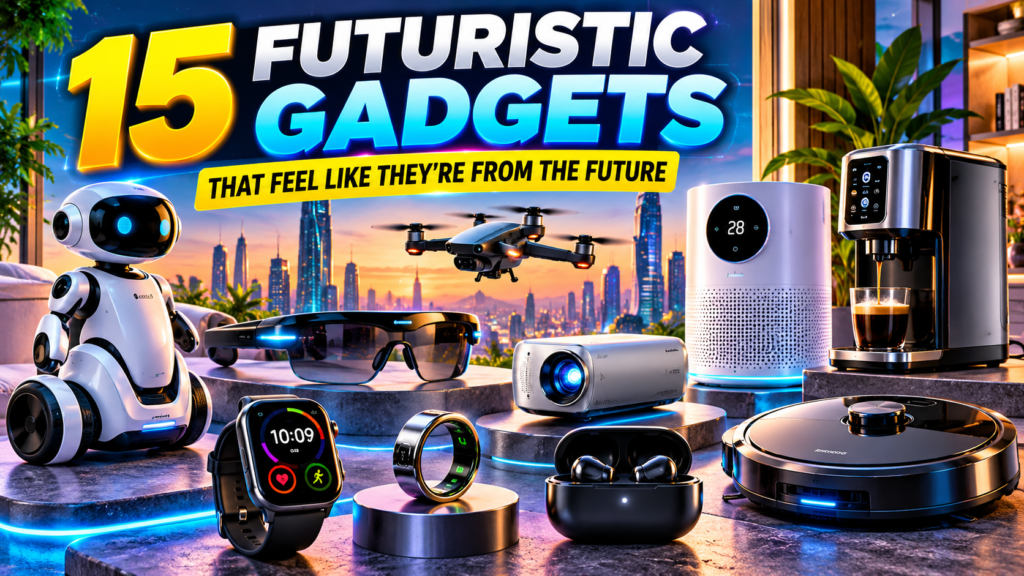
Here are 15 futuristic gadgets with their official brands, exact model names, and real-world performance breakdowns.
Wearable Tech You Can Wear Anywhere
- XREAL Air 2 Pro AR Glasses
Remember the awkward bulk of Google Glass a decade ago? Hardware company XREAL took that concept, stripped out the bulky plastic, and created a sleek pair of sunglasses weighing only 75 grams. The Air 2 Pro plugs directly into your iPhone, Steam Deck, or MacBook via USB-C to cast a virtual 330-inch screen right before your eyes. You can toggle between three levels of electrochromic dimming on the frame with the tap of a physical button. On a six-hour flight from Chicago to Los Angeles, I threw these on to stream movies without ever tilting my neck down toward a tray table. At around 449 dollars, they easily stand out among the most practical futuristic gadgets you can buy today. - Oura Ring Gen 4
Smartwatches are functional, but having a glowing glass rectangle buzzing on your wrist during a formal dinner gets old quickly. Finnish health tech brand Oura solved this problem by shrinking clinical-grade biometric sensors into an ultra-thin titanium band. The Oura Ring Gen 4 features recessed sensors that track blood oxygen saturation, sleep stages, body temperature variations, and cardiovascular age with pinpoint accuracy. The companion app uses machine learning to generate a daily readiness score, essentially telling you whether you should run five miles or take an afternoon nap. Retail starts at 349 dollars. - XPANCEO Smart Contact Lens Prototypes
While Oura handles the finger, deep-tech research company XPANCEO is working on the eye itself. Partnering with university laboratories, XPANCEO has developed working prototypes of smart contact lenses made from flexible medical polymers. These lenses incorporate micro-circuitry, transparent conductors, and biosensors to measure intraocular pressure for early glaucoma detection while testing head-up data projections. While you cannot buy these at your local eye doctor just yet, the company has completed successful laboratory testing and expects consumer regulatory submissions within the next three years.
Living Rooms From Tomorrow
- LG Signature OLED T
When LG announced the Signature OLED T, most industry writers assumed it would remain stuck in prototype limbo forever. Instead, LG brought it to commercial production. This 77-inch television features a completely transparent display panel that allows you to see the bookshelf or art hanging on the wall directly behind it when turned off. When you press the power button, a motorized black contrast film unrolls behind the glass to convert it into a standard, deep-black 4K display. It comes paired with LG’s Zero Connect Box, which beams audio and video wirelessly across the room. It carries a jaw-dropping retail tag near 20,000 dollars, making it a luxury statement piece, but it represents an unbelievable leap for transparent home entertainment. - Moley Robotics Kitchen
Cooking a healthy meal after a twelve-hour workday sounds miserable for most busy families. London-based engineering firm Moley Robotics tackled this headache by building the world’s first fully automated consumer robotic kitchen. The installation includes two articulated robotic arms equipped with tactile sensors, specialized cookware, and an induction cooktop. These mechanical arms mimic the exact hand movements of professional human chefs, stirring soups, flipping meats, and plating dishes before running a built-in steam cleaning cycle. Custom home installations cost upwards of 250,000 dollars, making it accessible only to ultra-wealthy homeowners, but the core engineering proves that autonomous home cooking is no longer a pipe dream. - Flyte Royal Levitating Light
Swedish design company Flyte builds minimalist home decor based around magnetic levitation. The Flyte Royal consists of an oak wood base and an Edison-style LED bulb that hovers in mid-air with zero physical strings or cables. The base houses an array of rare-earth magnets that stabilize the bulb, while an induction coil transmits electrical current across the empty air gap to illuminate the filament. You turn the light on and off simply by touching the corner of the wooden base. It retails for 299 dollars. Does it solve any massive global crisis? Not at all. But it remains one of those cool tech gadgets that every single houseguest will stare at in total disbelief. - Eight Sleep Pod 4
If you struggle with night sweats or wake up shivering at 3 AM, Eight Sleep offers the premier sleep fitness system on the market. The Pod 4 is an active cooling and heating mattress cover that zips over any standard queen or king mattress. A bedside water hub pumps temperature-regulated water through microscopic channels across the surface, letting each sleep partner pick independent temperatures between 55 and 110 degrees Fahrenheit. The system automatically shifts temperature during the night by tracking your heart rate and sleep cycles. Prices start around 2,500 dollars. Would you drop serious money on a smart cover that manages your bed climate? If you suffer from chronic insomnia, it might be the best investment in your entire bedroom.
Pocket Hardware That Shrinks Your World
- Motorola Rizr Rollable Concept
Foldable phones from Samsung and Google have become standard sights on city subways, but Motorola is pursuing an entirely different form factor with its Rizr concept. Instead of folding the phone in half along a visible hinge crease, the Rizr uses a motorized 5-inch screen that wraps around the bottom of the chassis. Double-tap the side button, and a tiny internal motor pushes the display upward, unrolling it into a tall 6.5-inch screen in about three seconds. While Motorola has kept the Rizr in active field-testing rather than full retail release, it shows where mobile hardware design is heading once consumers tire of clamshell foldables. - Serafim Keybo Laser Projection Keyboard
Taiwanese tech company Serafim developed a portable productivity accessory called the Keybo that turns any flat desk into a full workstation. The pocket-sized cube uses an optical laser projector to draw a glowing virtual keyboard onto wood, granite, or glass tables. Advanced infrared sensors track your fingers at speeds up to 350 characters per minute while delivering acoustic click feedback through an internal speaker. It also doubles as a portable power bank and a MIDI music keyboard for mobile composers, retailing for roughly 99 dollars. - Timekettle Fluentalk T1 Pocket Translator
Language translation software on phones often falls flat when you lose cell reception in an underground foreign subway station. Shenzhen-based audio company Timekettle built the Fluentalk T1 specifically to eliminate that headache. This dedicated handheld translator comes with built-in multi-frequency antenna arrays and two years of free global mobile data covering over 100 countries. It runs offline translation engines for 13 major languages, allowing two people to hold continuous back-and-forth conversations with latency under half a second. It sells for 299 dollars, making it an essential companion for international business travelers and vacationers. - Anker Nebula Capsule 3
Anker’s hardware brand Nebula created one of the most versatile outdoor entertainment devices with the Capsule 3. The entire unit shares the rough physical dimensions of a 12-ounce soda can, yet it packs a laser light engine producing 1080p high-definition video at up to 120 inches across. It runs Google TV natively, packs an internal 52-watt-hour battery capable of streaming a full two-and-a-half-hour film on a single charge, and houses eight-watt speakers tuned for open spaces. At 799 dollars, it completely changes how families approach backyard movie nights and camping trips.
Tools That Rewrite Physical Possibilities
- Oxford Nanopore Technologies MinION
Sequencing genetic material once required a university laboratory filled with industrial chillers and machines the size of refrigerators. British biotech pioneer Oxford Nanopore changed that model completely with the MinION. The device is barely larger than a standard USB thumb drive and plugs straight into an ordinary laptop running Windows or Linux. It reads long strands of DNA and RNA by passing individual molecules through microscopic protein nanopores, measuring fluctuations in electrical current. Field scientists routinely carry the MinION into rainforests to identify pathogens within hours. While priced around 1,000 dollars for the starter pack, it is a revolutionary tool that brings genetic research into the field. - Shift Robotics Moonwalkers
Pittsburgh robotics company Shift Robotics engineered Moonwalkers to accelerate pedestrian transit without the learning curve of rollerblades. Moonwalkers are battery-powered robotic shoes that strap over your regular athletic sneakers. An eight-wheel drivetrain powered by brushless DC motors uses ergonomic gait-tracking algorithms to match your natural stride. Instead of rolling freely down hills, they only spin when your feet move, allowing you to walk at speeds up to seven miles per hour with normal effort. They retail for 1,399 dollars. You look slightly quirky wearing them, but they cut walking commute times by over half. - LARQ Bottle PureVis
Reusable water bottles get smelly when left inside a gym locker for two days. Silicon Valley brand LARQ addressed this by integrating proprietary PureVis UV-C LED technology straight into the bottle cap. Every two hours, the cap automatically emits 280-nanometer ultraviolet light for sixty seconds, neutralizing up to 99 percent of bio-contaminants including E. coli and salmonella. You can also manually trigger an adventure mode cycle when filling up from freshwater rivers on a hike. The double-wall vacuum insulation keeps liquids cold for 24 hours, and the standard version costs 99 dollars. - Mudra Band by Wearable Devices Ltd
Israeli consumer tech maker Wearable Devices Ltd introduced the Mudra Band to replace touchscreens and voice commands for Apple ecosystem users. The strap replaces your standard Apple Watch band, embedding surface nerve sensors along the underside of your wrist. These sensors detect the minute bio-potentials sent from your brain through your motor nerves to your fingers. By simply pinching your index finger and thumb together or moving individual fingers, you can answer incoming phone calls, pause Spotify tracks, or navigate Apple TV menus from across the room without ever touching a glass screen. The band retails for 349 dollars.
What to Keep in Mind Before Buying New Tech
Picking up smart gadgets you didn’t know existed can be genuinely thrilling, but spending your hard-earned money on first-generation consumer tech requires some practical restraint.
Advantages:
- You receive immediate access to new user interfaces months before mainstream buyers.
- Hardware like the LARQ bottle or Eight Sleep Pod provides tangible, daily health improvements.
- They serve as fantastic icebreakers and conversation pieces at gatherings.
Drawbacks:
- Early manufacturing runs occasionally feature firmware bugs that take months to patch.
- Replacement parts and specialized batteries are harder to find if an early-stage startup shuts down.
In my experience reviewing hardware, if a device solves an existing daily frustration like poor sleep, language barriers, or heavy gear during travel, the early adopter price tag is usually worth it. If the product only serves as a visual party trick, wait for the second or third generation when prices drop and reliability improves.
Final Thoughts on Emerging Tech
Consumer technology moves at a dizzying pace. The futuristic gadgets that leave us stunned right now will likely feel completely mundane to the next generation of kids. That is the normal progression of consumer hardware. I still recall when home Wi-Fi felt like an impossible technical feat, and now we complain if an airplane seat lacks high-speed wireless video streaming over the ocean.
Take a quick look around your home office or kitchen this evening. Ask yourself which stubborn manual task wastes most of your precious free time. Chances are, a dedicated team of engineers is already putting the final touches on a smart device built to automate it.
Frequently Asked Questions
Which company makes the best smart ring currently?
The Oura Ring Gen 4 from Oura Health remains the overall industry standard due to its accurate sleep algorithms, titanium durability, and battery life that lasts up to eight days per charge. Competitors like the Ultrahuman Ring AIR and the Samsung Galaxy Ring also offer strong tracking features without mandatory monthly subscriptions.
Are transparent televisions like the LG OLED T practical for bright rooms?
The LG Signature OLED T works well in bright living spaces because it features an integrated motorized contrast screen. When lowered, you see through the glass panel. When raised, it blocks out ambient background light to preserve traditional color saturation and deep black levels comparable to standard OLED televisions.
Can the Timekettle Fluentalk T1 translate without an internet connection?
Yes, the Timekettle Fluentalk T1 comes pre-loade